
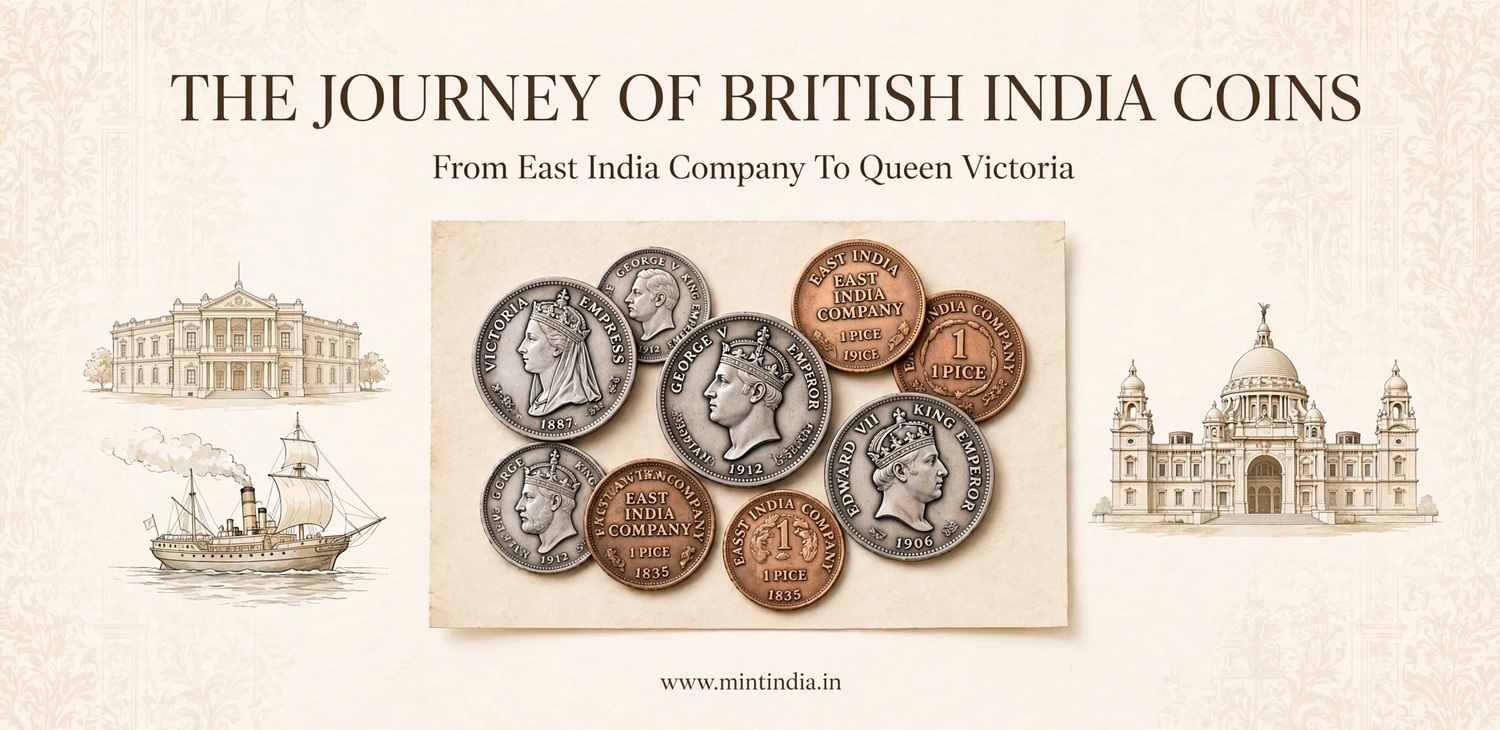
The Journey of British India Coins: From East India Company to Queen Victoria1757 to 1947. 190 Years. How a Trading Company Became an Empire - And Its Coins Told the Whole Story. If Mughal coins are poetry, British India coins are history in perfect English. Every British India coin has three things - a King or Queen, a date, and a story of how India slowly changed from Mughal Empire to British Raj. Let's walk this 190-year journey, coin by coin.
1. 1757 - The Company That Came to Trade, Stayed to Rule In 1757, after the Battle of Plassey, the East India Company won Bengal. They came to India to buy spices and cotton. But now, they had an army, a treasury, and a kingdom. And to run a kingdom, you need coins. But the Company could not just make its own coins. Indians trusted only Mughal coins. So what did the Company do? Smart Trick: They kept making coins in the name of Mughal Emperor Shah Alam II.A coin that says "Shah Alam II" but is actually made by the British in Calcutta. That is the start of British India coinage. Collector's Tip: These early Company coins look like Mughal coins - Persian writing, no English, no portrait. If you don't know the story, you will think it is a Mughal coin. That is the fun of it.
2. 1835 - The Big Change: William IV and The First English CoinsIn 1835, everything changed.For the first time, British India coins had:English writingA King's faceA fixed design for all IndiaKing William IV - the uncle of Queen Victoria.His silver Rupee had his head on one side, and on the other side - a lion, a palm tree, and the words EAST INDIA COMPANY with the value in English + Urdu + Bengali.This was the Uniform Coinage - one coin for the whole of India. From Peshawar to Madras, same Rupee.This is also where the famous British India Rupee system started:1 Rupee = 16 Annas1 Anna = 4 Pice1 Pice = 3 PiesIf your grandfather says "Athanni" (8 Annas) or "Chawanni" (4 Annas) - that system was born here.
3. 1840 - Queen Victoria: The Young Queen In 1840, a young 21-year-old Queen became the face of India's coins. Queen Victoria - Young Head. Her coins are beautiful. Young, with hair in a bun, wearing a crown. On the reverse - the value in a wreath. These coins ran from 1840 to 1858 under the East India Company, and then...In 1857, India revolted. The famous First War of Independence - Sepoy Mutiny. The Company lost. The British Crown took over directly. In 1858, Queen Victoria became the Empress of India. And the coins changed again.
4. 1862 - Victoria Empress: The Coins Every Collector Knows If you have ever seen an old British India coin in your dada-dadi's box, it is probably this one.1862 to 1901 - Victoria Empress Coins. Obverse: VICTORIA EMPRESS - with a crown Reverse: Value in wreath - ONE RUPEE, HALF RUPEE, QUARTER RUPEE, 8 ANNAS, 4 ANNAS, 2 ANNAS Metals: Silver for Rupee, Copper for Pice, later Bronze These are the most collected British India coins in the world. Why? They are available They are affordable - a Victoria Rupee starts from Rs. 200-300They have dates, mints, and varieties - Bombay, Calcutta, Madras The Famous 1862 Dot Varieties: Collectors go crazy for small dots on these coins. A small dot after the date can make a Rs. 300 coin become Rs. 30,000. That is the magic of British India collecting. Mint Marks to Learn: Bombay Mint: Small dot or no mint mark, later "B"Calcutta Mint: No mint mark Madras Mint: Later "M"Once you learn mint marks, you will never look at a coin the same way again.5. 1877 - The Empress Becomes Kaiser-i-Hind In 1877, in Delhi Durbar, Queen Victoria was declared Kaiser-i-Hind - Empress of India. From then, coins said VICTORIA EMPRESS in full glory. And in the same period, India got its first modern copper coins - 1/12 Anna, 1/2 Pice, 1/4 Anna. Tiny, beautiful, with Victoria's head. These small copper coins were used by common people - to buy vegetables, to pay for a rickshaw, to give to a beggar. When you hold one, you are holding the daily life of 1890s India.6. 1901 - Edward VII: The King Who Loved India Victoria died in 1901 after 63 years. Her son Edward VII became King. His coins (1903-1910) are different - he is shown without a crown, wearing a simple uniform. More human, less royal. Edward VII Rupee is famous for one thing - The Pig Rupee. In 1903, on the 1 Rupee coin, the elephant on the reverse looked like a pig to many Muslims. People refused to use it. The British had to change the design. This one coin teaches you - in India, coins are not just money. They are emotion, religion, culture.7. 1911 - George V: The King in a Crown George V (1911-1936) brought back the crown . His coins are the most beautiful of British India, according to many collectors. Obverse: GEORGE V KING EMPEROR - with crown, in full royal robe Reverse: Clean, bold value And in 1911, something historic happened - the Delhi Durbar. George V came to India, sat on the throne in Delhi, and was crowned Emperor in front of lakhs of Indians. To remember this, special 1911 Durbar Medals were made. If you find one, it is a treasure. George V period also gave us:1/2 Rupee, 1/4 Rupee, 2 Annas, 1 Anna - in Nickel and Silver1/12 Anna, 1/2 Pice, 1/4 Anna - in BronzeAnd the famous 1918, 1919, 1920 coins - minted during World War I, when silver was scarce. Some years are very rare.8. 1936 - George VI: The Last King, The War Coins George VI is the father of Queen Elizabeth II. The king you saw in the movie The King's Speech. His coins (1938-1947) are the last British India coins.And they have two special stories: Story 1 - The War: During World War II (1939-1945), silver became too expensive for coins. So the British started making coins in Nickel and Nickel-Brass. A 1 Rupee coin that is not silver? That was shocking for Indians. These are called War Issues. A 1943-1944 Nickel Rupee is a must-have for every collector. Story 2 - The Lion: For the first time, George VI coins had the Lion Capital of Sarnath - the same lion that is India's National Emblem today. Look at a 1947 George VI Rupee. It has the Lion. Look at a 1950 Republic India Rupee. It also has the Lion. That Lion is the bridge. British India ended, but India kept its symbol. In 1947, India became free. George VI coins stopped. And a new journey began - Republic India Coins.How To Start Your British India Collection – TODAY This is the easiest collection to start. And the most rewarding.Step 1 - Start with Victoria Empress Rupee (1862-1901): Rs. 250 onwards. Learn dates, mints.Step 2 - Make a Set of 1 Rupee, 1/2 Rupee, 1/4 Rupee, 2 Annas, 1 Anna: One Queen, 5 coins. This is your first set.S tep 3 - Add Edward VII + George V: Compare the portraits. See how the crown changes. Step 4 - Add George VI War Coins: Nickel Rupee, 1943, 1944, 1945. Feel the war in your hand.Step 5 - Look for Errors & Varieties: Dot varieties, over-dates, die cracks. This is where a Rs. 300 coin becomes Rs. 30,000.Pro Tip: Always check weight and edge. British India silver Rupee is 11.66 grams. If weight is wrong, coin is fake. At mintindia, every coin is weighed and checked. Final Thought British India coins are not just coins of a foreign ruler. They are the diary of India:1835 - India gets one Rupee for all1857 - India fights for freedom1911 - A King comes to Delhi1943 - A World War changes our money1947 - India becomes free When you hold a British India Rupee, you are holding 190 years of India's most dramatic story. And when you complete your set - Victoria to George VI - you have not just collected coins. You have collected India's journey to freedom.
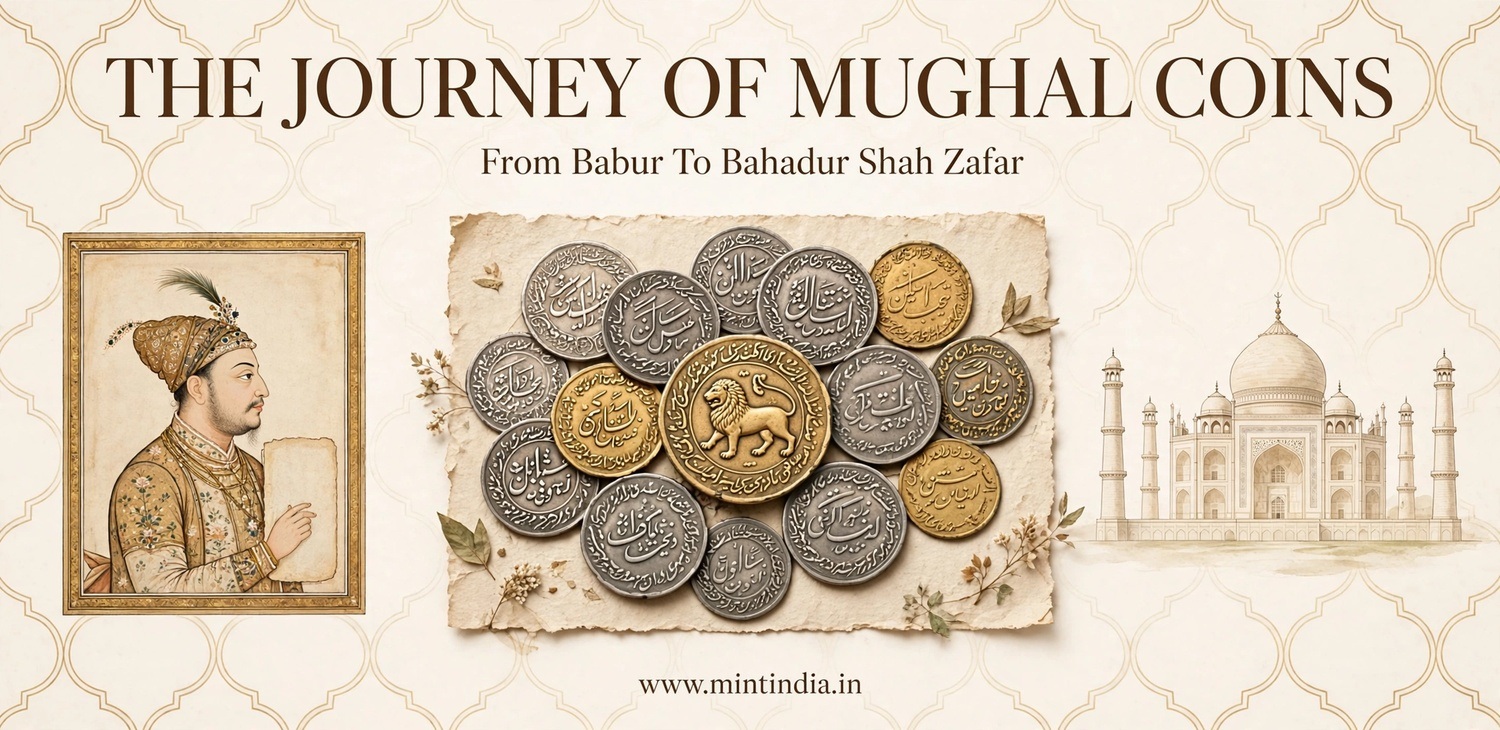
INDIAN PRINCELY STATE AND MUGHAL COINS
THE JOURNEY OF MUGHAL COIN
The Journey of Mughal Coins: From Babur's First Rupee to Aurangzeb's Empire of Gold1526 to TODAY. 300 Yea...